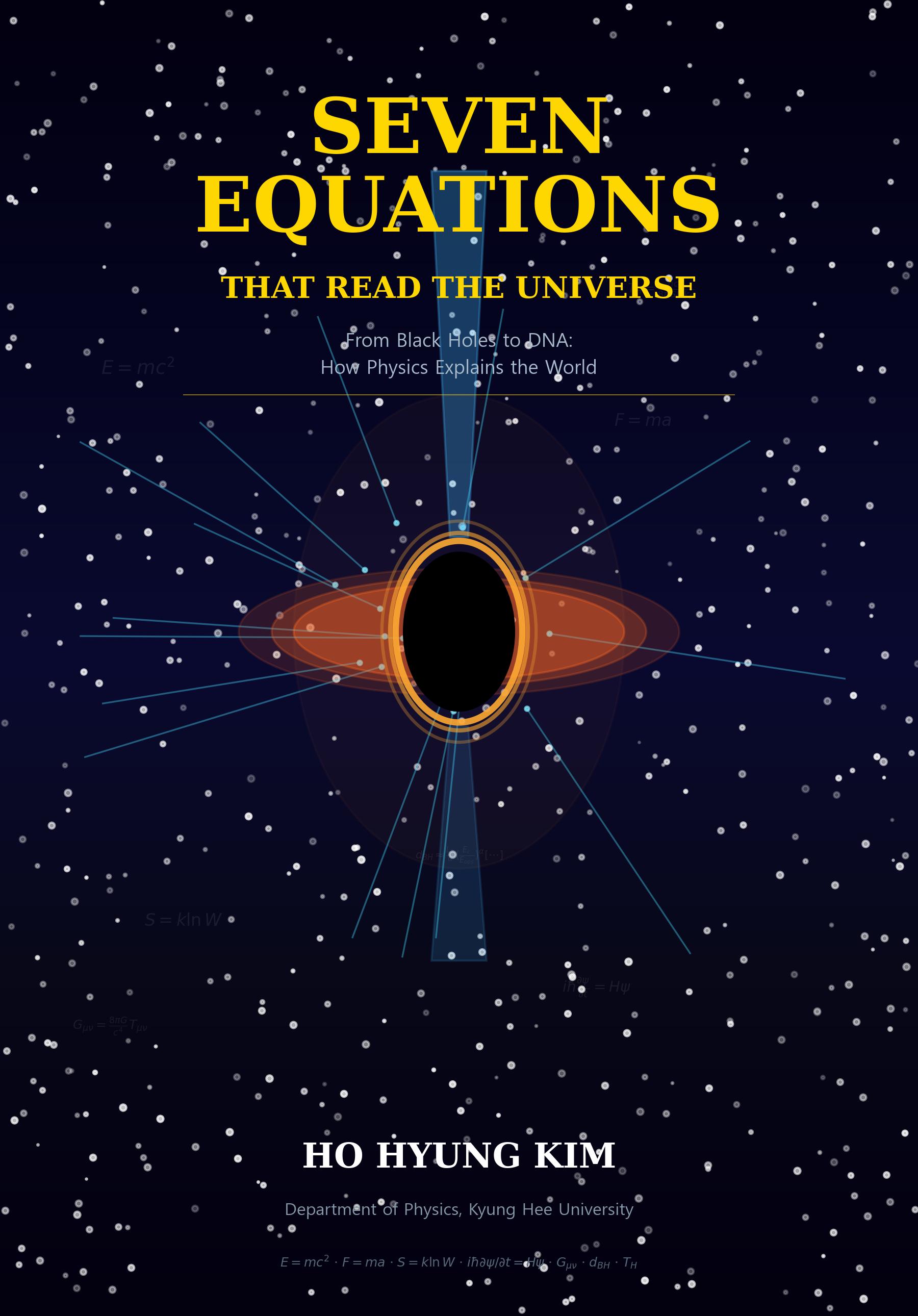
From Black Holes to DNA: How Physics Explains the World
Ho Hyung Kim · Department of Physics, Kyung Hee University · Popular science / Physics · April 2026
Who fired the Amaterasu particle? In 2021, a cosmic ray carrying 244 EeV of energy struck Earth from a direction with no obvious source. This book follows that mystery through seven equations—from Einstein and Newton to quantum mechanics, black holes, and Hawking radiation—without requiring advanced mathematics.
Seven Equations That Read the Universe is written for general readers who want a big-picture view of physics without heavy formalism. The book explains why seven equations matter, how they connect historically, and where they still point beyond established science.
The narrative runs from Einstein and Newton to entropy, quantum mechanics, black holes, ultra-high-energy cosmic rays, and Hawking radiation. Instead of teaching derivations, it focuses on stories, intuition, and physical meaning.
The central thread is the Amaterasu particle and the broader puzzle of how modern physics links energy, force, disorder, quantum structure, gravity, and the fate of black holes. The distance formula discussed in Chapter 6 is the author's proposed framework for asking how far an ultra-high-energy cosmic ray could travel; it is presented as a research hypothesis, not an established law.
Primary search phrases: Seven Equations That Read the Universe, Ho Hyung Kim, Seven Equations That Read the Universe Ho Hyung Kim.
Main Chapters
E = mc² explains mass-energy equivalence, stars, nuclear energy, and why relativity changed modern science.
F = ma follows Newton from falling apples to orbital motion, rockets, and modern navigation.
S = k ln W introduces entropy, the arrow of time, and the logic of disorder.
Schrödinger's equation opens quantum mechanics through atoms, semiconductors, lasers, and uncertainty.
Einstein's field equation moves into curved spacetime, black holes, and gravity on the largest scales.
The distance formula connects the Amaterasu particle, black hole acceleration, and ultra-high-energy cosmic rays.
Hawking temperature closes with black hole evaporation, information loss, and quantum gravity.
Start with the Mystery
A single proton-scale projectile arrived with the kinetic energy of a macroscopic object, yet its reconstructed direction did not point to an obvious accelerator. Chapter 6 explains how air-shower detectors measured it, why magnetic fields complicate source tracing, and what propagation distance can—and cannot—tell us.
Curious readers who want the big ideas of physics without a calculus-first textbook.
Space and astronomy readers drawn to black holes, cosmic rays, and unsolved source questions.
Students and educators looking for an intuitive bridge between famous equations and current research.
Search FAQ
What is Seven Equations That Read the Universe? It is an English popular science physics book by Ho Hyung Kim about seven equations that connect relativity, Newtonian mechanics, entropy, quantum mechanics, black holes, cosmic rays, and Hawking radiation.
Who is the author? The author is Ho Hyung Kim. The name may also appear as Kim Ho Hyung or 김호형.
How should readers search for it? Use the exact title Seven Equations That Read the Universe, the author name Ho Hyung Kim, Kindle ASIN B0GX2PQP9M, or paperback ASIN B0GX26JHZP.